Wednesday, December 14, 2011

Seven Reasons Why Doctors Write

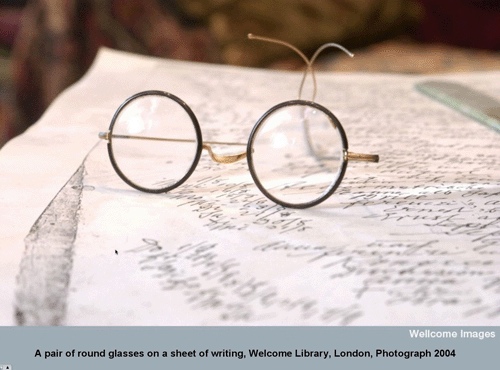
A pair of round glasses on a sheet of writing, Wellcome Library, London, Photograph 2004

Commentary by Tony Miksanek, M.D., family physician, short-story author, and coeditor, Literature, Arts, and Medicine Database

As a profession, physicians are a remarkable group of writers. What doctors lack in good penmanship is more than compensated for by their skill in penning stories and poems. Their literary accomplishments are even more impressive given a lack of formal training in the art of writing. Only a few physician-authors have MFA degrees. Most medical students do not major in English or literature while in college. Doctors become talented writers the old-fashioned way. They practice. They also teach themselves via voracious reading with attention to style and technique. They occasionally attend writing workshops.

It helps that doctors are immersed in stories. If the business of medicine is taking care of patients, then the currency used in the transaction are the narratives of illness told by patients and received by physicians. Doctors spend a good chunk of their professional lives listening to stories. It's only natural that doctors would retell versions of these tales or craft their own new ones. All the elements of a story are readily available to any doctor: plot, protagonist, antagonist, setting, dialogue, and theme. Physicians witness struggle - disease, death, and suffering - all the time. Writers call it conflict. Physicians regularly observe cures, acts of heroism, and even miracles. Writers refer to it as denouement. Doctor-writers have oodles of experience to tap from. They have a rich pipeline of poignant images, unforgettable language, colorful characters, and vexing irony in any single day. In addition, physicians get plenty of practice writing and editing office notes, consultations, and histories & physicals.

There is an elite roster of physician-writers for readers to drool over. Anton Chekhov, John Keats, Arthur Conan Doyle, William Carlos Williams, A.J. Cronin, W. Somerset Maugham, and Mikhail Bulgakov are a few names that immediately come to mind. There are also many recognizable physician-writers including Michael Crichton, Robin Cook, and Frank Slaughter who may not get the love (critical acclaim) but certainly get the money (commercial success). There is a sizeable but unquantifiable group of practicing physicians who engage in creative writing without fanfare. These doctors take their writing seriously whether they consider it a hobby, diversion, or passion. I estimate that as many as 4-7 percent of all practicing physicians in the United States are currently working on a poem, story, or novel.

With hectic, unpredictable, and stressful jobs, why do doctors want to write? Given the demands and responsibilities associated with a career in medicine, why do so many physicians make time to write? The short answer is that doctors write for many of the same reasons that non-physicians do: They feel compelled to write. They have something to say. They love words and language. They are excited by the process and gratified by the result. They are inspired.

Here are seven special reasons (ranked from most important to least important) why doctors write:

1. Therapy - Physician heal thyself. Nothing promotes healing like writing a poem or short story or even a single glorious sentence. Writing helps a doctor get things off their chest in a much more productive way than yelling at a nurse, ranting at a patient, or being grouchy at home. Poems and stories written as a form of therapy are easy to spot. They have a confessional quality.
2. Exploration - Doctoring is hard. Creative writing is an opportunity for physicians to make sense of what they do. Stories written for the purpose of searching sometimes have themes that focus on medical ethics and boundary issues.
3. Sharing - Doctors can pass along knowledge and experience by writing in clever and vivid ways. Humor and compassion provoke memorable moments in literature. A perfect example is The House of God by Samuel Shem.
4. Joy - Writing is fun. Okay, maybe not always - rewrites, editing, and the evil "writers' block." At some level (the spark that begins the project or reading the finished manuscript), there is euphoria. Would you settle for glee?
5. Honor - Writing allows physicians an opportunity to memorialize patients and colleagues. These literary works feature a fictionalized version of a character or an amalgamation of a few people. Creative writing can immortalize someone. P.S.: Doctor-narrators also reap literary longevity.
6. Atonement - Doctors make mistakes. They sometimes behave badly. They have regrets. Stories and poems can be part of their penance. Think "Brute" by Richard Selzer.
7. Notoriety - Let's not lie to ourselves. Who among us would not want to be a rich and famous author? I don't know any doctors who would turn down a Pulitzer Prize, National Book Award, or an appearance on The Oprah Winfrey Show. Good luck with that.

Remember The Nurses

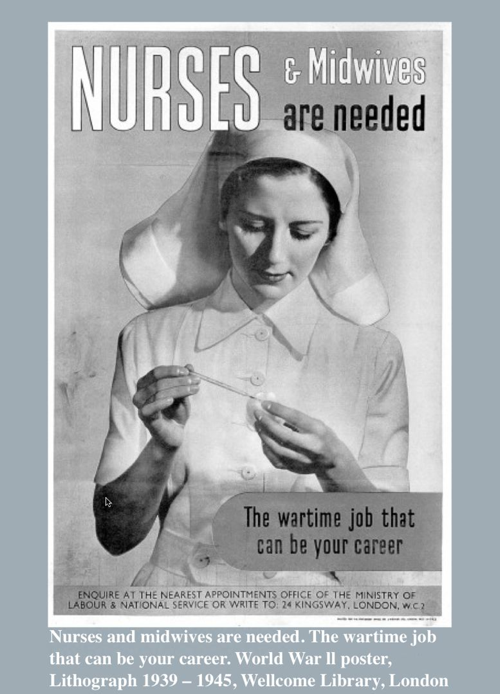
Remember the Nurses - Lithograph 1939 - 1945, Wellcome Library, London
Commentary by Thomas Lawrence Long, Associate Professor-in-Residence, School of Nursing, University of Connecticut

Name three popular physician writers working today.
Atul Gawande. Pauline Chen. Oliver Sacks. Jill Bolte Taylor. Jerome Groopman. Rafael Campo. Deepak Chopra. Edward de Bono. Andrew Weil.

Well, that was easy.
Now name three physician authors who are part of the Western literary canon.
Hippocrates. Galen. The author of the Gospel According to Luke and of Acts of the Apostles. Hildegard of Bingen. Charles Eastman. Arthur Conan Doyle. Anton Chekhov. William Carlos Williams. Oliver Goldsmith. Thomas Browne. John Polidori. Oliver Wendell Holmes, Sr. Lewis Thomas. Thomas Bowdler (unfortunately).

An embarrassment of riches. That was easier still.
Now name three nurse authors, who are either writing today or are part of the literary canon.
All right, I'll give you twenty-four hours to get back to me.

Where Are the Nurse Writers?

Paradoxically, the healthcare professional field established by a prolific Victorian English author, Florence Nightingale (whose 1859 Notes on Nursing: What Nursing Is, What Nursing is Not has never gone out of print), finds few of its writers on the tips of our tongues. And even at the origins of professional nursing in the United States during the Civil War, one of America's most beloved authors, Louisa May Alcott, started her literary career with Hospital Sketches, an account of her experiences as a nurse in a military hospital.

Why are there so few well known nurse authors? And what nurse writers are ready to be discovered by a larger audience?

When I have asked nurse editors and scholars the first question, the answers have centered on two points. First, nursing has often been viewed (and until recently nurses viewed themselves) as ancillary, literally ancilla, handmaiden, a feminized, subservient profession deferring to the physician. Not only was the nurse not expected to have insights into the human condition; she (and the nurse usually was female) did not have the "room of one's own" to enable reflection and literary productivity. The physician had his (and the physician usually was a man) office as a retreat, while nurses just had . . . the nurses station-a public location at the hub of medical care and utterly lacking in privacy or solitude.

Second, nurses often were not educated for their profession in the tradition of the liberal arts and sciences. Instead they were frequently trained in hospital nursing programs, or since the second half of the twentieth century at community colleges in two-year associate of science degree programs. Baccalaureate programs in nursing have been a feature of the nursing curriculum since earlier in the twentieth century, but many nurses even today are not the products of that broadly general education.

Nursing Writing

Nurses seem uniquely equipped, however, to comprehend the whole person of the patient, spending considerably more time with the sick than physicians do and aware of the entire psychological, social, and spiritual inflections of their patients. Nurses have historically been encouraged to keep journals and diaries of their clinical experiences, so the raw material for memoir is in fact at hand. As Jane E. Schultz observes of the contrast between clinical accounts by Civil War military physicians and those by their nurses:

Though nurses' styles of self-expression differed widely, they wrote about their patients with a singular degree of material specificity, and they resisted surgeons' tendency to blur patients' individual characteristics. In their letters and diaries, they referred to patients by name, frequently mentioning hometowns, culinary tastes, or other distinguishing details. Often they quoted their conversations with soldiers, which surgeons who kept diaries rarely did. . . Surgeons' diaries do not show nearly the same individualization of suffering. They were more likely to refer to their patients in the abstract or to refer to the clinical details of a particular treatment without mentioning the soldier's name at all. (378-379)
Civil War nurse diaries are among the more vivid and moving accounts of the war, whether from the hand of the domestic Louisa May Alcott, or the sensationalist S. Emma E. Edmonds, author of the memoir Nurse and Spy in the Union Army. Moreover, feminist critic and literary scholar Elaine Showalter in an introduction to Florence Nightingale has characterized Nightingale as a major literary figure in English feminism, bridging Mary Wollstonecraft in the eighteenth century and Virginia Woolf in the twentieth.

Who are Nightingale's literary descendants working today? They are men and women, and they are many. They are working in a variety of genres, and their work has earned frequent anthologizing. Cortney Davis and Judy Schaefer's two collections, Between the Heartbeats: Poetry and Prose by Nurses (1995) and Intensive Care: More Poetry and Prose by Nurses (2003), have brought nurse writers to a wider audience. Schaefer's more recent anthology, The Poetry of Nursing: Poems and Commentaries of Leading Nurse-Poets, gives 15 nurse poets the space to present and to comment on three or four of their own poems, an unusual and engaging meta-analysis. An accomplished poet, Davis is also a talented essayist, whose recently published The Heart's Truth: Essays on the Art of Nursing encapsulates the relationship between clinical practice and writing:

. . . I find that when I'm not seeing patients, it's a struggle for me to write. It seems that for me, nursing and writing have become, over the years, inextricably bound. That intimate connection that links us, human to human, is essential both to my vocation and my avocation. (98)
Writers like Davis and Schaefer, Jeanne Bryner, Theodore Deppe, Veneta Masson, have published their work in distinguished literary journals, such as Minnesota Review, Prairie Schooner, Hudson Review, Poetry, The Sun, and Kenyon Review, as well as in their own books published by respected presses.

These nurse writers join an eclectic canon. Katherine Prescott Wormeley (1830-1908), an American nurse in the Civil War, was a highly respected literary translator, who turned works by Balzac, Daudet, and Dumas to English. Sarah Chauncey Woolsey (1835-1905), an American children’s author and editor, wrote under the pen name Susan Coolidge. Lillian D. Wald (1867-1940) was a community health activist and author of two memoirs, The House on Henry Street (1911) and Windows on Henry Street (1934). Ellen LaMotte (1873-1961) published several books, including travel and wartime nursing narratives. In addition, today nurse scholars publish their research in over 100 journals of nursing science and professional practice.

Florence Nightingale, whose collected works now runs to thirteen volumes in the edition published by the Canadian University of Guelph's Wilfrid Laurier University Press, put pen to paper in the service of a variety causes, not all of them related to health care. As Lytton Strachey observes in his profile of her in Eminent Victorians, Nightingale's dedication to spirituality led her to write a tract on the spiritual wellbeing of working-class artisans:

Then, suddenly, in the very midst of the ramifying generalities of her metaphysical disquisitions there is an unexpected turn, and the reader is plunged all at once into something particular, something personal, something impregnated with intense experienceaa virulent invective upon the position of women in the upper ranks of society. Forgetful alike of her high argument and of the artisans, [she] rails through a hundred pages of close print at the falsities of family life, the ineptitudes of marriage, the emptinesses of convention, in the spirit of an Ibsen or a Samuel Butler. Her fierce pen, shaking with intimate anger, depicts in biting sentences the fearful fate of an unmarried girl in a wealthy household. It is a cri du coeur . . .
The best of nursing writing shares this passion, a thirst for justice, an advocacy of vulnerable populations. Nightingale did not suffer fools gladly, and her view of the role of nurses went well beyond the ancillary, for as she wrote, "No man, not even a doctor, ever gives any other definition of what a nurse should be than this — ‘devoted and obedient.’ This definition would do just as well for a porter. It might even do for a horse. It would not do for a policeman."

Works Cited

Alcott, Louisa May. Hospital Sketches. Boston: J. Redpath, 1863.

Davis, Cortney. The Heart's Truth: Essays on the Art of Nursing. Kent, OH: Kent State University Press, 2009.

Davis, Cortney, and Judy Schaefer, eds. Between the Heartbeats: Poetry and Prose by Nurses. Iowa City: University of Iowa Press, 1995.

—. Intensive Care: More Poetry and Prose by Nurses. Iowa City: University of Iowa Press, 2003.

Edmonds, S. Emma E. Nurse and Spy in the Union Army. Hartford, CT: W. S. Williams & Co., 1865.

Nightingale, Florence. Notes on Nursing: What Nursing Is, What Nursing is Not. London: Duckworth, 1859.

Schaefer, Judy, ed. The Poetry of Nursing: Poems and Commentaries of Leading Nurse-Poets. Kent, OH: Kent State University Press, 2006.

Schultz, Jane E. "The Inhospitable Hospital: Gender and Professionalism in Civil War Medicine." Signs, 17.2 (Winter, 1992), pp. 363-392.

Showalter, Elaine. "Florence Nightingale." Sandra M. Gilbert and Susan Gubar. The Norton Anthology of Literature by Women: The Traditions in English. New York: W.W. Norton, 1996. 836-837.

Strachey, Lytton. Eminent Victorians. New York: Putnam, 1918. Retrieved from http://www.bartleby.com/189/204.html

Wald, Lillian D. The House on Henry Street. New York: Holt, 1915.

—. Windows on Henry Street. Boston: Little, Brown, 1934.

Nurse-Poet-Writer Cortney Davis Responds To Thomas Long’s Blog On Nurse Writers

Commentary by Cortney Davis, MA, APRN, Nurse practitioner, Sacred Heart University Health Services, Fairfield, Connecticut

Thank you to Dr. Thomas Long for his excellent blog entry and for his continued championing of nurses' writing. I also wonder why nurse-writers don't have a wider audience. Specifically, as I see more and more narrative medicine courses offered to medical students, I wonder why many nursing programs still fail to utilize the creative writing of nurses-why not narrative nursing courses? After reading Dr. Long's blog, I asked my husband, a physician, why he thought nurse writers were not as well respected (and as widely read) as doctors who wrote. His answer was immediate: "Authority," he said. "People think that because doctors have more authority in the work place, they also have more authority on the page." There is certainly some truth in this, as Long points out. Doctors are often seen as the embodiment of strength and "curing" and nurses, whether male or female, are often seen as the embodiment of a softer, more feminine "caring"-and I think there are other factors at work here as well.

One reason nursing programs may have been slow to incorporate nurses' writing is the myth of "natural empathy." Some have assumed that those who go into nursing are already compassionate and empathic (sometimes they've even been seen as bleeding hearts, ruled by the emotions and not by the mind). Therefore it might seem that nursing students, those sensitive souls, wouldn't require the humanities to awaken them to their patients' suffering. The companion myth is that of the "distant physician." It's often assumed that medical students are more interested in the illness than in the patient and therefore would benefit from studying the humanities in order to become more empathic providers. Of course, neither myth is valid, although there is a kernel of truth in both. Indeed, when nurses first began publishing their creative writing, some of that writing was overly sentimental and, in some cases, poorly crafted. When doctors first began offering their creative writing, some of it was overly cerebral and occasionally cold. Now, after several decades, nurse- and doctor-writers have honed their skills and found their voices; the best of them are accomplished, professional and writing on equally high levels.

Another factor relates both to the question of who has the authority and to the myth of natural vs. learned empathy. "Nursing Education," that big generic machine, for many years also viewed, if secretly, physicians' work as having more authority, if not more worth, than nurses' work. This bias was spurred on by many things, including the belittling of the nursing profession by doctors, by hospital administration, by the media, and sometimes even by patients and nurses themselves. This led nursing educators to do their best to rid nursing programs of any hint of "softness"-that natural empathy taken to its limits-and to forge nursing education into a research-based, scientific endeavor. As Long notes, this brought the study of nursing from the hospital bedside to the classroom. Almost at the same time, in the 1970s, along came "medical humanities," the study of literature meant, among other things, to foster more empathic, nurse-like compassion in medical providers. As medical schools began offering courses in the arts, humanities and creative writing as a way to increase students' awareness of the "softer side" of caregiving, nursing programs hurried ever farther away from touch and ever closer to technology.

Nursing, it seems to me, missed the boat; only now is it, in some instances, trying to catch up. Still, the majority of nursing programs today have neither the time nor the inclination to offer humanities or writing courses to student nurses. If nursing students are asked to keep journals, the journals are too often seen as an exercise tangential to the real studies; when medical students are asked to keep journals, the journals are often lauded as intimate glimpses into the trials and triumphs of learning medicine-and some of those journal entries are published as beacons to guide other medical students. If the majority of nursing programs are not honoring the creative writing of nurses and using that writing to help guide their students, should we wonder why the names of the best nurse-writers producing poems, essays and novels today are not well known?

That said, some interesting things are happening which give me hope that, little by little, nurses' writing is moving into a more mainstream consciousness. Nurses' creative writing, while still for the most part under utilized within nursing education (and here let me recognize and thank Thomas Long and the many other educators who do value nurses' writing and fight to include it in their courses), is becoming more and more visible, as Long also points out, in the "secular" literary world. Rattle, an excellent and widely read literary journal, featured a "Tribute to Nurses" in the winter 2007 issue, publishing poems and essays by 24 nurses. Many of the poetry volumes, novels and essay collections by nurse-writers have been published by literary presses-among them the University of Iowa Press, Calyx Books, Beacon Press, Random House, and Kent State University Press-rather than by nursing presses. Many nurse-writers have won impressive literary awards-including National Endowment for the Arts Fellowships-which have no connection to nursing or medicine. It seems to me that nurses who write are finding new and exciting outlets and are being recognized not as nurse-writers but as writers.

Yet, within the halls of nursing and medical education, until we move beyond myth and presumption and accept that nurses and doctors are co-workers in the same mysterious and amazing world of caregiving; that we all long to find ways to deal with the complicated emotions our work engenders; that we all want to know what others like us are thinking and feeling; and that we all have essential stories and important contributions to make to students and to the humanities canon-well, until then, we nurses who write, although literary equals to physicians who write, will not enjoy equal recognition.

Humanity Out of Context: Tinkers as a Touchstone for Dissection


Editor's Note: I met Rachel Hammer, a third year medical student and MFA candidate at the Mayo Clinic, last month at the American Society of Bioethics and Humanism conference in Minneapolis where she presented a poster about a student poetry group. When I mentioned that I worked at Bellevue, she told me about a recent meeting at the medical school where the novel, Tinkers, was discussed in a narrative medicine group. Tinkers, as many of you know, was published by the Bellevue Literary Press and received a Pulitzer Prize for fiction. I asked Rachel if she would write about the group and its discussion of Tinkers.
Commentary by Rachel Hammer, MS3 and MFA Candidate, Mayo Medical School

The Mayo Clinic College of Medicine's Narrative Medicine group started in response to an ornament in Evelyn Waugh's Brideshead Revisited. A skull sits in a bowl of roses in the dorm room of Waugh's protagonist, Charles Ryder, in a section entitled, "Et En Arcadia Ego." Arcadia, legend has it, is the field described by Pliny the Elder where a shepherd wet his finger with spit and traced his friend's shadow against a tomb-the first painting-suggesting whilst setting the precedent that art is inspired when humans face their mortality. Art, thus, is humankind's response to death.

After hours in the medical school anatomy lab in the first year, we had stared at skulls and the dead long enough to stir substantial need for creative expression. A group of us began to meet to read poetry and excerpts from novels. I had read Rita Charon's Narrative Medicine, and visited the Masters Program at Columbia, where I learned some basic exercises in "attention, representation, and affiliation" and so I offered to facilitate the sessions. We are graciously funded by the Walt Wilson Art in Medicine grant. Our group meets for lunch once a month and is open to all medical students. Students sign up to attend, and we cap the group at twenty members. I choose the excerpts, usually something I come across in my MFA coursework.

For the October meeting I chose to read from Tinkers by Paul Harding, a work that I thought would resonate with first year students going through the emotional and physically arduous anatomy block. The excerpt (pages 178-184), was the touchstone for a discussion on experiences of cognitive dissonance when bearing witness to humanity out of context, such as the discomfort one may experience in dissecting a cadaver.

Tinkers is broken into segments with alternating narrators, Howard, the father, and George, his son, each tell the stories of their lives, with modest overlap. Real time in the book works backward, counting down the last days of George's life; time within memories works forward. Father and son as co-protagonists are like two gears, intimately related and yet spinning with force and purpose all their own.

In the excerpt, George, near death, loses consciousness in the living room where he lay in his bed surrounded by family. As always in our Narrative Medicine group practice, we read the passage to ourselves, closely, deliberately. Then we read the passage again, together, aloud. We then discuss what we recognize, what surprises us, and what it means to us, today, as we chance to encounter it.

We were struck by the language of natural elements Harding used to describe the dying bodies: Salt, wood, minerals, legs like planks, feet like lead weights, salt-cured, metal strengthened, dried veins, strong as iron chains, exhausted engine, bushings. Someone remarked that in other settings, when humans are described reductively in terms of their elemental components, their inner workings likened to the machinery of a clock, we are repulsed. How dare we consider humans as mere material! But in the space of death, written with the reverence of a poet, George returning to mere material is a beautiful, honorable fate. Recognizing that George spent his life as a clockmaker-that there was nothing for which he had more passion than clocks-his, then, is a righteous transfiguration indeed; that in death, he would morph to resemble the very thing he most loved in life, the wood, the chains, the lead weights, the bushings of a clock.

One student linked the end of the passage (p.184) to themes of TS Eliot (The Four Quartets was a previous reading in this group). She recognized the confusion of time in the space of death and grief-"imagining was as it is still approaching"-as a collision of past and future. Sharing our fears of death for ourselves, worry of bodily pain, we saw in ourselves the family Harding describes hovering around George:

(…"that they mourn because of the inevitability of the was and apply their own wases to the it [dead body], which is so nearly was that it will not or simply cannot any longer accept their human grief) as its broken springs wound down or its lead weights lowered for the last, irreparable time."

We discussed the extent to which our efforts in palliation and comfort are more for the provider than the patient. How some things are irreparable, and how seldom we can admit this to ourselves.

Since this passage was intended for the reflection of the first year students, as they loom over their assigned dead bodies like belated Fates, I asked them to reflect on the language in this passage while contemplating what it means to be dead, and what it means to encounter the dead. As you pick away at the crust of another human, now lifeless, out of context, consider the story that lies beneath. Our bodies, universes unto themselves, are, in fact, neither simple nor always logical, but ever so elegant.